Bike enthusiasts and DIY power projects often need reliable watt meters to monitor energy usage, voltage, current, and efficiency. This guide highlights top watt meters that suit bikes, ebikes, solar setups, and portable power testing. Each pick offers clear readouts, multiple display modes, and safety features to help you track consumption without guesswork. The selection emphasizes user-friendly interfaces, accuracy, and durability in compact formats.
Summary of selected products
| Product | Brand | Key Focus |
|---|---|---|
| Upgraded Watt Power Meter Plug Home Electrical Usage Monitor | MECHEER | Home energy monitoring with 7 display modes |
| Upgraded Watt Meter Power Meter Plug Home Energy Monitor | MECHEER | 8 display modes, overload protection |
| 150A High Precision Power Analyzer Multi Meter | HTRC | DC power analysis with high precision |
| Upgraded Watt Meter Power Meter Plug With Cord | MECHEER | 7 display modes, backlight, 5 backlight settings |
| P3 P4400 Kill A Watt Electricity Monitor | P3 | Classic Kill A Watt with wide readouts |
MECHEER Upgraded Watt Power Meter With Backlight
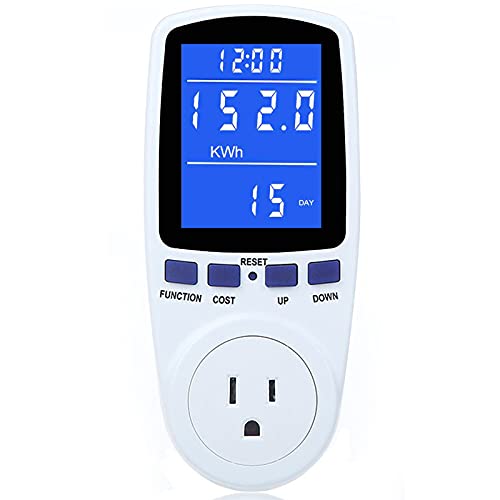
The MECHEER unit provides real-time monitoring of power (W), energy (kWh), voltage (V), current (A), frequency (Hz), and power factor, with cost estimates and peak measurements. It features 7 display modes, enabling quick shifts between essential parameters while an appliance runs. A large backlit LCD (2.36″ x 1.85″) ensures clear readings day or night, and a wide 180-degree viewing angle helps you record data from various angles. This model also offers adjustable backlight timing for customizable visibility.
Key advantages include a comprehensive data set for energy budgeting and an accessible interface that supports quick checks during bike-related projects or portable power testing. The device is designed for US socket compatibility and emphasizes safety with overload indicators and protective housing. It’s suited for monitoring ebike chargers, auxiliary loads, or charging stations where precise consumption matters.
MECHEER Upgraded Watt Meter With 8 Display Modes

This MECHEER model expands on display versatility with eight modes, including annualized cost estimates and total usage. It measures power (W), energy (kWh), voltage (V), current (A), frequency (Hz), and power factor, plus unit price and total cost for long-term tracking. An overload protection feature flashes a warning if the load surpasses the safe threshold, which adds a safety layer for bike charging rigs or portable power setups. The unit uses a durable ABS shell designed for frequent use and US plug compatibility.
For bike projects, this option is helpful when evaluating chargers, battery packs, or accessory loads. The combination of clear readouts, backlight customization, and a straightforward display makes it a strong candidate for field testing and routine energy audits of gear related to biking power needs.
HTRC 150A High Precision DC Power Analyzer
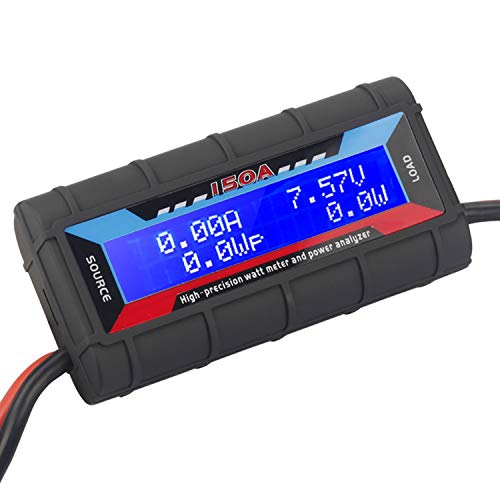
This high-precision DC power analyzer handles voltages from 0 to 60V and currents up to 150A with a 0.01A resolution. It displays DC voltage, current, watts, amp-hours, and watt-hours, plus peak measurements and minimum voltages. Its blue backlit LCD provides easy readability, and its robust wiring supports higher current tests common in battery projects, solar setups, or DIY ebike builds. The device is ideal for bench testing or field checks when diagnosing DC-powered bike components, chargers, or battery banks.
Although primarily designed for DC systems, the meter’s accuracy and wide measurement range support a variety of bike-related power testing tasks. The included display clarity aids quick interpretation of results, while the compact form factor fits into portable testing kits used by enthusiasts and professionals alike.
MECHEER Upgraded Watt Meter With Cord

This variant mirrors the earlier MECHEER meters but includes a corded connection setup for flexible installations. It covers power, energy, voltage, current, frequency, power factor, and cost, with seven display modes to track parameters while an appliance operates. The large LCD with backlight, 180-degree viewing, and options to adjust backlight duration offer practical visibility during bike charging sessions or mobile power tests. The device emphasizes safety with overload indicators and a durable shell suitable for frequent use.
The corded design helps in bike-related experiments where a direct connection to a charger, power pack, or accessory is needed. It provides clear, actionable data to assess charging efficiency, device draw, and potential savings over time, making it a practical tool for hobbyists and hobbyist mechanics working with biking power systems.
KILL A WATT Connect P4498 Monitor

The Kill A Watt Connect model provides a familiar, easy-to-read interface for monitoring volts, amps, watts, frequency, and power factor. Its 35-inch cord length lets you position the display in a convenient spot while the plug remains accessible in tight spaces. It offers hour-by-hour, daily, weekly, monthly, and yearly cost tracking, making it a solid choice for bike accessories, chargers, and portable power setups. The device emphasizes straightforward interpretation and broad utility for both hobbyists and more formal energy audits.
For bike enthusiasts testing various charging arrangements, this model helps quantify high- and low-load scenarios, assess energy costs over time, and compare different adapters or chargers with a familiar Kill A Watt workflow.
Proshopping 300A High Precision Watt Meter

The Proshopping meter measures current up to 300A and supports a wide voltage range (DC 7–60V), suitable for battery banks, RC setups, solar arrays, and ebike power tests. It displays current, voltage, watts, amp-hours, watt-hours, peak amperage, minimum voltage, and peak watts. With 0.01 A and 0.01 V resolution, it delivers detailed insights for precise tuning of bike power systems. The device is designed to be compatible with a variety of DC configurations common in DIY e-mobility projects.
Its 8-in-1 functionality makes it useful for both troubleshooting and performance optimization, allowing you to monitor instantaneous draw, cumulative energy, and efficiency across different test scenarios. This is particularly valuable when evaluating battery health, charger efficiency, and overall system energy awareness for biking applications.
Buying Guide: Key Purchase Considerations
When choosing a watt meter for bike projects, consider these factors to ensure you pick a device that matches your needs:
- Measurement scope: Decide which parameters you need (W, kWh, V, A, Hz, PF, cost). Some models emphasize broad data, others focus on essential readings for quick checks.
- Display quality: Look for backlit LCDs with wide viewing angles and large numbers for easy reading in varying lighting conditions, including outdoors or garage setups.
- Display modes: More modes offer flexibility, letting you switch between real-time readings and cumulative cost or energy usage. Ensure mode switching is intuitive.
- Safety and durability: For bike and portable setups, choose units with sturdy housings and overload indicators to prevent misuse when testing high loads.
- Connection style: Corded vs. plug-in meters affect placement and convenience. Consider the space around your charger, battery pack, or bike electrical system.
- Voltage and current range: Ensure compatibility with your system’s voltage (DC 12V–60V commonly used in bikes and ebikes) and expected current (A) ranges.
- Portability: If you test in different locations, a compact, lightweight meter with clear data is preferable for field use.
- Accuracy and resolution: Higher resolution (0.01 in listed meters) yields more precise data—particularly valuable when diagnosing small changes in battery or charger performance.
- Price vs. value: Compare features against cost. A model with more modes and a clear display might justify a higher price if it improves usability and data quality for bike projects.
In practice, for bike-related testing, prioritize meters with clear readouts, sufficient current range, and modes that reveal both instantaneous usage and cumulative costs. For DIY ebike builds, DC-capable meters with robust construction and accurate power and energy measurements tend to deliver the most actionable data over time. Always follow safe charging practices and use meters within their rated specifications to protect both equipment and users.