Finding the right semi vertical bike rack can transform cluttered garages and apartments into tidy, accessible storage spaces. This guide reviews five top picks that balance compact footprint with sturdy construction, so you can select a model that fits your bikes, space, and budget. Below you’ll find an at-a-glance summary, followed by detailed sections for each option and a practical buying guide to help you compare features, mounting options, and durability.
| Product | Type | Capacity | Best For |
|---|---|---|---|
| Sttoraboks Vertical Bike Stand | Freestanding Upright | Up to 55 lb / 25 kg | Renters and quick setup |
| Ultrawall Freestanding Bike Rack | Vertical Freestanding | Up to 4 bikes | High-capacity vertical storage |
| Delta Michelangelo 2 Bike Storage Rack | Freestanding Gravity | Up to 80 lb (per pair) | Compact footprint, stylish finish |
| monTEK Freestanding Storage Rack | Vertical Stand | Up to 5 bikes | Heavy-duty, adjustable height |
| Steadyrack Wall Mounted Rack | Wall-Mounted Pivot | Road, hybrid bikes | Slim footprint, easy access |
Sttoraboks Vertical Bike Stand Review

The SttoraboksVertical Bike Stand is a freestanding upright rack that offers adjustable height for bikes with wheels up to 29 inches and tires up to 4 inches wide. Its design emphasizes stability and ease of movement, with four 360° lockable rolling wheels that help you rearrange a space without permanent installation. The rack can support bikes up to 55 lb / 25 kg and features an adjustable lifting system to suit different bike dimensions. Note that bikes with fenders or baskets may not fit this model, so verify wheel profiles before purchase.
Two key strengths are its portability and renter-friendly setup. Because it does not require drilling, it can be moved between rooms or homes as needed. The adjustable height helps accommodate a range of bikes—from compact road bikes to mountain bikes—while the wide compatibility keeps a variety of tire widths stable. Users who prioritize wall preservation and temporary storage will appreciate its mobility and footprint.
Ultrawall Freestanding Bike Rack

The Ultrawall Freestanding Bike Rack is designed for vertical storage and can hold up to four bicycles without mounting to a wall. Built from heavy-duty steel, it uses four welded hooks rated to 100 lbs each, delivering substantial stability for multiple bikes in a single footprint. The freestanding design frees up wall space and is particularly suitable for garages, sheds, or kid-friendly rooms where a permanent installation isn’t feasible.
Pros include its simple assembly and the advantage of stacking bikes in a vertical configuration, which dramatically improves floor space usage. It’s an excellent choice if you want a high-capacity, moveable solution that doesn’t require wall anchors or studs. Potential drawbacks include a larger footprint than some wall-mounted options and the need for a flat, unobstructed floor to prevent tipping when fully loaded.
Delta Cycle Michelangelo 2 Bike Storage Rack
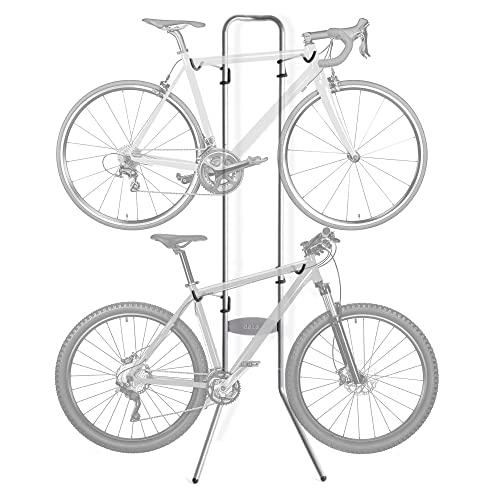
Delta Cycle’s Michelangelo two-bike gravity stand offers a stylish, space-saving approach with a wall-lean design that requires no permanent mounting. The stand holds up to 80 lbs total (40 lbs per bike) and provides a slim footprint ideal for apartments or small garages. Adjustable arms and a powder-coated steel finish ensure compatibility with most road, MTB, and hybrid bikes. Rubber feet keep the stand stable and protect flooring from scratches while maintaining a clean aesthetic.
Key advantages include its freestanding construction and elegant appearance, which makes it suitable for living spaces where visual impact matters. Because the design relies on gravity rather than clamps or hooks, setup is straightforward. However, some heavier bikes or wider tires may require careful positioning to maximize stability, and the unit’s footprint can be larger than wall-mounted options in tight spaces.
monTEK Freestanding Storage Rack for 5 Bikes

The monTEK freestanding rack is a heavy-duty vertical system designed to hold up to five bikes, with 4 large locking casters for easy relocation. It features a 49″-78.5″ height adjustment range and 55 lb (per hook) capacity for the primary hooks, along with additional helmet and utility hooks. The design emphasizes a protective crossbar to shield both bikes and walls from scratches, and the lateral adjustability of bike hooks enables accommodation for e-bikes, road bikes, and kids’ bikes alike. The caster system supports on uneven floors and reduces floor damage during movement.
Strengths include its capacity and customization options. It’s well-suited for households with multiple bikes and a need for flexible configuration. Potential downsides involve assembly complexity and a need for adequate floor space to allow the rack to be rolled and locked securely when loaded.
Steadyrack Bike Rack

Steadyrack’s original wall-mounted vertical bike storage system uses a pivot design to store most road, hybrid, and commuter bikes with tires up to 2.1″ wide and wheel sizes 20″–29″. Since its inception in 2009, Steadyrack has prioritized space-saving vertical storage with a pivot mechanism that makes bike access simple and unobtrusive. The Classic Road Rack’s steel construction promises durability, while the pivot feature minimizes the space required for parking and retrieval, making it a practical option for narrow garages or apartments lacking floor space for freestanding units.
Considerations include compatibility with tire width and wheel size, as certain wider tires or fenders may not fit the pivoting arm. The wall-mount approach also means you’ll need secure wall anchors and stud availability. For users prioritizing a minimal floor footprint and a sleek, fixed installation, this is a dependable choice.
Buying Guide: Key Purchase Considerations
- Space and footprint: Determine whether a freestanding or wall-mounted design best fits your space. Freestanding racks offer mobility and wall preservation, while wall-mounted options maximize floor space but require solid mounting surfaces.
- Bike types and tire widths: Check compatibility for tire width, wheel size, and presence of accessories like fenders or baskets. Some models accommodate up to 4″ tires, while others specialize for 2.1″ widths or specific wheel sizes.
- Weight capacity: Consider the weight of your bikes (and potential e-bikes). Ensure the rack’s per-bike or total capacity aligns with your fleet.
- Adjustability: Look for height and arm adjustability to fit road, mountain, and fat-tire bikes. Vertical racks with adjustable hooks can accommodate a wider range of bikes.
- Stability and protection: Prioritize models with stabilizing feet, locking casters, or crossbars to protect bikes and walls from scratches during storage and movement.
- Assembly and installation: Some units require minimal assembly, while others need tools for mounting to floors or walls. Renters may prefer no-drill freestanding designs; homeowners might opt for wall-mounted options for a cleaner look.
- Accessibility and maintenance: Consider how easy it is to access bikes in tight spaces and how often you’ll need to move the rack for cleaning or rearrangement.
- Materials and durability: Steel constructions with powder coatings tend to offer long-term durability and resistance to rust, especially in garages or outdoors.
In choosing among semi-vertical options, balance your need for floor space, bike variety, and whether you want a portable unit or a fixed installation. If you own multiple bikes and value high capacity, a freestanding rack with locking casters can simplify reorganizing. For sleek, furniture-like storage, a wall-mounted pivot rack provides excellent space efficiency, provided you have suitable wall anchors. Review each product’s compatibility notes and measure your space to ensure a precise fit.