The rise of indoor cycling has made road bike trainers essential for consistent workouts, rain or shine. This guide highlights five reliable indoor trainers that suit a range of bikes, from 26–28″ wheels to 700C, with varying resistance levels and quiet operation. Whether you’re chasing endurance, intervals, or steady base miles, these trainers offer stability, easy mounting, and realistic ride feel for American riders training at home.
Below is a concise summary of the five selected products to help you compare at a glance. All models support common road and mountain bikes, and each includes setup features like quick-release skewers or front wheel riser blocks to simplify installation and transition between indoor and outdoor riding.
| Product | Wheel Compatibility | Resistance | Notable Feature |
|---|---|---|---|
| Sportneer Bike Trainer | 26–28″ / 700C | 6 levels | Quick-release lever; front wheel riser |
| CXWXC Bike Trainer | 26–29″ / 700C | 6 levels | Drive-by-wire control from handlebars |
| Alpcour Bike Trainer Stand | Road & Mountain bikes | 6 levels | Quiet magnetic system, foldable |
| Saris Mag and Mag Plus | Rear-wheel-on | Variable resistance | Quieter, smooth ride; Zwift compatible |
| Wahoo KICKR CORE 2 | All compatible road bikes | High-end | Road-like feel, advanced connectivity |
Sportneer Bike Trainer for 26-28″ Wheels
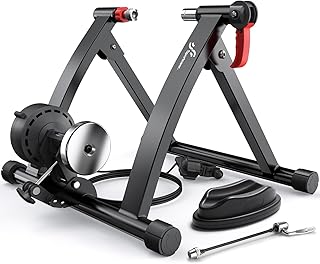
The Sportneer indoor trainer supports most road and mountain bikes with 26–28″ or 700C wheels, and rear axles between 4.92″–6.57″. It includes a quick-release skewer for fast setup and offers six magnetic resistance levels. A designated front wheel riser block stabilizes the bike and helps level the overall trainer footprint. For wheels using a thru axle, Sportneer also offers an adapter variant for perfect compatibility, making it a flexible option for diverse bike fleets.
Resistance is engaged via a bar-mounted remote, allowing users to shift through six levels to mirror flat rides up to steep climbs. This feature supports interval training and progressive overload without leaving home. The quick-release lever simplifies mounting and removal, enabling quick transitions between indoor sessions and outdoor rides. The overall build emphasizes stability and ease of use, ideal for beginners and seasoned cyclists alike.
CXWXC Magnetic Bike Trainer for 26–29″ Wheels

The CXWXC trainer is designed to handle a wide wheel range from 26″ to 29″ including 700C, offering robust support with a maximum load capacity suitable for diverse riders. Its drive-by-wire control enables you to adjust resistance from the handlebars, delivering a six-level progression in seconds. The pyramid-styled frame contributes to high stability during intense workouts, reducing wobble and enhancing confidence while you pedal through simulated climbs. The combination of solid construction and accessible controls makes it a versatile option for indoor training regimens.
Aside from security and strength, the unit emphasizes user-friendly setup with a quick-release skewer for easy mounting. The included front wheel riser block further helps to stabilize the bike within a compact footprint, ensuring a clean, organized training zone. This model is well-suited for riders who value direct resistance control and a stable indoor platform for endurance sessions or structured intervals.
Alpcour Bike Trainer Stand

Alpcour’s trainer converts any mountain or road bike into a stable indoor ride, featuring a foldable, portable design that reduces storage space when not in use. The magnetic resistance system runs quietly, delivering a smooth pedaling feel that mimics outdoor cycling. Six fixed resistance levels let riders simulate flat terrain to steep climbs, while the high-quality flywheel and reduced friction extend the life of tires. An extra-wide base and low stance contribute to excellent balance, even during vigorous sprints or heavy gear changes.
Setup is straightforward, and the included bag makes it convenient to transport to a garage, studio, or training space. The quiet operation and sturdy construction appeal to riders who need consistent, distraction-free workouts during early or late training hours, or for those recovering from an injury who require controlled, predictable resistance.
Saris Mag and Mag Plus Indoor Bike Trainer

The Saris Mag and Mag Plus uses a wheel-on, rear-wheel-on design that attaches to the bike’s rear wheel, eliminating the need to remove the wheel. It delivers a quiet, consistent ride thanks to a fluid resistance mechanism, with a decibel profile around 69 decibels at 20 mph. The linear resistance profile helps riders align effort with gear changes, making it suitable for varied workouts from tempo rides to threshold efforts. For Zwift users, it offers compatibility within the broader ecosystem of smart trainers, though it’s primarily a non-smart option without extra sensors.
Because the trainer leverages a wheel-on setup, it’s quick to assemble and may be ideal for riders who prefer simple, reliable operation and straightforward maintenance. The quiet performance and predictable resistance curve provide a dependable indoor training experience for all levels of cyclists seeking efficiency and consistency.
Wahoo Fitness KICKR CORE 2

The KICKR CORE 2 is positioned as a premium indoor trainer with a focus on a road-like ride feel and robust connectivity. It features improved setup speed and easier connections to apps and devices, along with an authentic resistance profile that mirrors real-world cycling. The “Core” designation reflects a balance between performance and price, offering advanced features in a compact form factor. The trainer is built to handle hard workouts, with a reputation for reliability and accuracy in power data, making it a favorite for serious athletes and structured training programs.
Users can pair the KICKR CORE 2 with popular training apps for adaptive workouts, virtual rides, and data-driven coaching. Its smooth resistance curve supports high-intensity intervals and long endurance sessions alike. While it sits at a higher price point, the long-term value comes from durable construction, precise calibration, and strong ecosystem support for indoor training enthusiasts.
Buying Guide: Key Purchase Considerations And Comparisons
Choosing the right indoor trainer depends on your bike compatibility, intended training style, and noise tolerance. Here are essential factors to weigh:
- Wheel compatibility: Ensure the trainer supports your bike’s wheel size (26–29″ and 700C are common ranges) and axle type (quick-release vs thru-axle). Some models offer adapters to broaden compatibility.
- Resistance mechanism: Magnetic resistance is budget-friendly and quiet, whereas fluid or direct-drive systems simulate more realistic road feel and precise power data. Consider your preferred training intensity and any data-tracking needs.
- Mounting and stability: A stable base with a wide footprint reduces wobble during sprints and high-power efforts. Look for front wheel stabilization and sturdy frames.
- Noise level: If you train early mornings or late evenings, a quiet trainer is crucial to avoid disturbing others. Review decibel ranges and flywheel quality.
- Setup and maintenance: Quick-release setups save time and reduce hassle. Some trainers require wheel removal; others are wheel-on. Maintenance needs vary by mechanism and materials.
- Connectivity and app support: If you use virtual training platforms (Zwift, TrainerRoad, The Sufferfest), verify compatibility and data accuracy, including power readings and cadence data if relevant.
- Portability and storage: Foldable designs or compact footprints help when space is limited. Check weight and transport options if you plan to move the trainer frequently.
- Cost vs. value: Higher-end models offer realistic ride feel and advanced features, but mid-range trainers deliver solid performance for most home setups. Consider long-term usage and upgrade paths.
When evaluating these five models, consider your existing bike setup, the level of realism you require, and how much you value quiet operation versus portability. For recreational riders, budget-friendly wheel-on trainers with six resistance levels may suffice. For performance-focused cyclists, direct-drive or premium wheel-on options with accurate power data and advanced connectivity provide the best training experience. Always verify current compatibility with your specific bicycle components before purchasing.