Transform any standard bicycle into an efficient electric ride with a high-quality hub motor kit. The following five kits represent strong options for front and rear hub setups, offering power, reliability, and user-friendly displays. Each kit includes essential components like a throttle, PAS, and LCD display to help you monitor speed, battery life, and assist levels. This guide highlights standout choices, comparing power, wheel compatibility, and installation considerations to help American riders pick the best kit for hills, commutes, or weekend adventures.
| Product | Brand | Power | Wheel Size | Type |
|---|---|---|---|---|
| VEVOR 1000W Electric Bike Conversion Kit | VEVOR | 1000W | 26″ | Front |
| MOCHAG 1500W Ebike Conversion Kit | MOCHAG | 1500W | 20″ | Rear |
| AW 1000W 26″ Front Wheel Kit | AW | 1000W | 26″ | Front |
| PEXMOR 1200W Front Wheel Kit | PEXMOR | 1200W | 26″ | Front |
| LTIGOAW 1000W Rear Wheel Kit | LTIGOAW | 1000W | 26″ | Rear |
VEVOR 1000W Front Hub Kit With LCD And PAS

The VEVOR kit centers a 1000W brushless DC motor designed for 26″ wheels, delivering up to 420 rpm and rated torque around 50 N.m. Its performance supports climbs up to 12 degrees and handles varied terrains with stability. The kit includes a high-definition LCD display for real-time ride data—speed, distance, PAS level, and battery life—enhancing situational awareness and safety. Copper-core construction contributes to heat resistance and durability, while a reinforced 26″ wheel improves grip and reliability in adverse conditions. This front-wheel option suits riders seeking balance and straightforward installation on road and light off-road bikes.
MOCHAG 1500W Rear Hub Kit With PAS And LCD

This rear-hub kit from MOCHAG offers a powerful 1500W motor with a focus on efficiency and quiet operation. It features a PAS sensor for assisted pedaling and an LCD display to monitor speed, battery level, mode, and potential faults. Built with robust materials like rubber, stainless steel, and copper, the kit emphasizes durability and resistance to wear. Its design supports multiple terrains—from city streets to gravel paths—and emphasizes long-term reliability. The included throttle and gearing-free motor provide smooth acceleration without regular maintenance associated with brushed motors.
AW 1000W 26″ Front Wheel Kit With Dual Mode Controller
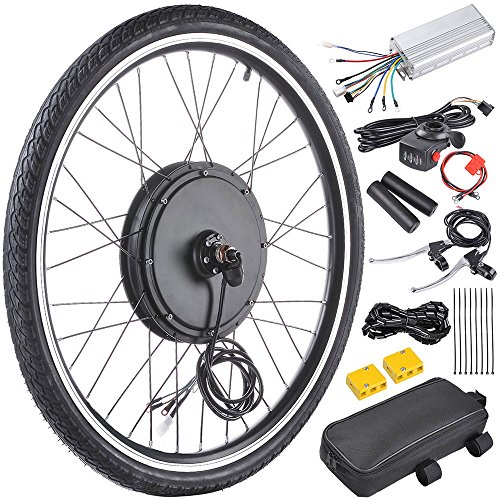
The AW kit uses a 48V 1000W brushless hub motor, enabling up to 45 KM/H (approximately 28 MPH). It’s built for stability, with an aluminum frame that supports up to 220 pounds and a drive system free from chains or gears for low friction. The included thumb throttle features three battery indicators for quick status checks, aiding in battery management. Compatibility spans most 26″ frames and both disc and V-brake setups, making it a versatile option for a wide range of bicycles seeking front-wheel electric boost without complex drivetrain changes.
PEXMOR 1200W Front Hub Kit With 3-Mode Controller

The PEXMOR kit features a powerful 1200W front hub motor suitable for 26″ frames with 100mm/3.93″ front dropout spacing. It offers a versatile 3-mode controller (Hall effect and non-Hall effect operation) and a sine-wave controller for improved efficiency and low-noise performance. The kit supports Pedal Assist System (PAS) along with throttle and presets to tailor ride feel. This configuration is well-suited for riders who want strong hill-climbing capability and a smooth, quiet ride without excessive maintenance.
LTIGOAW 1000W Rear Wheel Kit With LCD Display

The LTIGOAW rear kit delivers 1000W with a focus on durability and stability, featuring an aluminum frame construction and a robust rear hub motor designed for reliability on inclines. The kit includes an LCD display to track speed, distance, voltage, and diagnostics, plus a 5-speed adjustment and cruise control for extended rides. Suitable for 26″ frames, it targets riders who want strong rear-wheel assistance for urban hills and longer commutes, with emphasis on smooth throttle response and consistent power delivery.
Buying Guide: Key Purchase Considerations
- Wheel compatibility and dropout spacing: Confirm front or rear wheel hub compatibility with your bike’s dropout spacing (commonly 100mm for front or 135mm for rear). Some kits support universal disc brake or V-brake configurations, while others are limited to certain frame types.
- Power and speed: Hub motors range from 1000W to 1500W in these options. Higher wattage typically provides better hill-climbing ability and faster top speeds, but may require a more capable battery and stronger frame.
- Controller type and efficiency: Sine-wave controllers or 3-mode controllers influence ride smoothness and efficiency. Hall-effect sensors can affect torque behavior but may enhance response consistency in some models.
- Display and PAS features: An LCD display that shows speed, distance, battery level, and faults helps with maintenance and planning. Pedal Assist System (PAS) levels, throttle modes, and cruise control can reduce fatigue on longer rides.
- Durability and materials: Look for copper-core motors and corrosion-resistant components for longevity, especially if you ride in wet or harsher climates. Aluminum frames and reinforced wheel builds can improve overall reliability.
- Braking compatibility: Ensure the kit is compatible with your brakes (disc or rim brakes) to maintain braking performance at higher speeds.
- Weight and ride feel: Front-wheel kits can affect steering feel, while rear-wheel kits add traction benefits under acceleration. Consider your riding style, terrain, and preferred handling.
- Maintenance and serviceability: Brushless gearless motors require less maintenance than brushed alternatives. Check warranty terms and whether replacement parts are readily available in the U.S.
When selecting a kit, balance power with the bike’s frame strength, battery capacity, and your typical riding conditions. A higher-powered kit paired with a robust battery can deliver strong uphill performance for daily commutes, while mid-range options may suit casual riders seeking a boost in flat-terrain riding. Always verify installation requirements, electrical safety, and local regulations regarding e-bike classifications before purchase.