For riders seeking precise indoor guidance, a bike trainer with a power meter provides instant data on wattage, cadence, and resistance. This guide highlights five top options that blend power measurement with realistic feel, compatibility with popular training apps, and easy setup. Each selection targets different budgets and needs, from smart connectivity to manual resistance. Read on to compare features, supported software, and how to choose the right power-enabled trainer for your goals.
Product Overview
| Product | Brand | Key Features |
|---|---|---|
| Garmin Tacx Boost Trainer | Garmin Store | Speed sensor, 10 levels, up to 1050 watts, compatible with Tacx Training app and TrainerRoad |
| ThinkRider X2Max Smart Trainer | ThinkRider Store | BLE & ANT+, power up to 2000W, 18% tilt resistance, realistic map-matching |
| Sportneer Smart Bike Trainer | Sportneer Store | Bluetooth & ANT+, supports Zwift Onelap Proudy, data sensors for power/speed/cadence |
| Saris M2 Smart Indoor Trainer | Saris Store | Wheel-on design, +/-5% accuracy, quiet electromagnetic resistance |
| Sportneer Magnetic Trainer | Sportneer Store | 6-level resistance, quick-release setup, compatible with 26–28″ wheels |
Garmin Tacx Boost Trainer, Indoor Bike Trainer

The Garmin Tacx Boost blends a compact wheel-on trainer with power-capable performance. It includes a speed sensor to track pace, distance, and ride data, enabling compatibility with leading apps like the Tacx Training app and TrainerRoad when paired with a supported device. It fits rear axle widths of 130 mm (Race) and 135 mm (MTB), with adapters available for other widths. A strong magnetic brake provides up to 1050 watts of resistance, while a handlebar-mounted lever manually adjusts resistance across 10 levels. This setup is suitable for structured workouts and endurance rides where wattage tracking matters.
ThinkRider X2Max Smart Bike Trainer Cycle Trainer
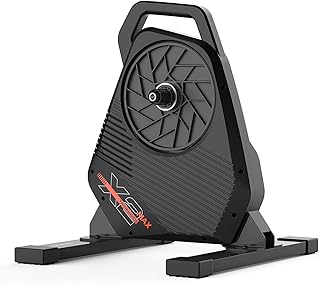
The ThinkRider X2Max is designed for indoor cycling with smart connectivity and a powerful power meter. It supports BLE and ANT+ dual-mode protocols and works with major cycling software such as ZWIFT. With a robust power output of up to 2000W and an accuracy of about ±2%, this trainer emphasizes precise training data. An intelligent tilt resistance of 18% mirrors real-world gradient changes when connected to compatible software, delivering a more realistic training environment and immersive rides.
Sportneer Bike Trainer: Smart Bike Trainer Stand

The Sportneer Smart Bike Trainer is a versatile option that supports wheel sizes from 26″ to 29″ and 700C, accommodating rear axles from 3″ to 6.37″. It ships with a quick-release skewer and provides Bluetooth 4.0 and ANT+ connectivity for pairing with Zwift, Onelap, Powerfun, and Rouvy AR. Integrated sensors measure power, speed, and cadence, and data can be streamed to a connected device for real-time feedback. An adapter is available for thru-axle bikes, expanding compatibility for a wide range of setups.
Saris M2 Smart Indoor Electromagnetic Trainer

The Saris M2 M2 combines a wheel-on design with electromagnetic resistance for controlled, consistent workouts. With a focus on quiet operation (approximately 69 dB at 20 mph) and a stated training accuracy of ±5%, this trainer emphasizes stability and repeatable performance. It’s designed to work with the Zwift app, enabling interactive workouts and virtual routes. This trainer is well-suited for riders who want dependable data without the highest-end power specs of premium smart trainers.
Sportneer Bike Trainer – Magnetic Stationary
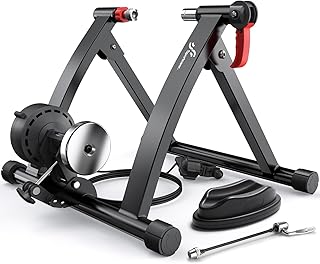
This magnetic trainer from Sportneer provides a straightforward indoor riding experience with six resistance levels. It’s compatible with 26–28″ and 700C wheels and includes a quick-release lever for easy mounting and dismounting. A front wheel riser block helps balance the set-up, and a version with a Thru Axle Adapter is available for riders using thru-axle bikes. The trainer emphasizes simplicity and reliability for riders who want effective structure during home workouts without advanced power metrics.
Buying Guide: Power-Enabled Indoor Trainers
- Power measurement: Look for trainers with a built-in power meter or better, a sensor suite that provides accurate wattage data with minimal drift. Note typical accuracy ranges (±1–3% is common for high-end, ±5% for some mid-range models).
- Connectivity: BLE and ANT+ compatibility enables seamless pairing with popular apps like Zwift, Rouvy, TrainerRoad, and the vendor’s proprietary software. Confirm app compatibility before purchase.
- Resistance and fidelity: If you want realistic climbs, seek trainers with high resistance ranges and simulated gradients. Smart trainers with dynamic resistance can reproduce slopes when paired with software with map data.
- Wheel compatibility: Check rear axle width and tire compatibility. Some trainers require adapters for different hub widths (e.g., 130 mm vs. 135 mm) or disk-style thru-axles.
- Noise and stability: Wheel-on designs can be noisier than direct-drive units, but many balance performance with reduced weight and noise. Consider the room where you’ll train and whether quiet operation is important.
- Software ecosystem: If you prefer a specific app, verify that the trainer integrates well with it. Some units excel with Zwift and Rouvy, while others pair better with Garmin or Tacx ecosystems.
- Ease of setup: Quick-release skewers, included adapters, and stable frame support reduce setup time. If you need to move the trainer often, consider the overall footprint and portability.
- Future-proofing: Some trainers offer firmware updates and ongoing software support. This ensures access to new features and improved accuracy over time.
When selecting a power-enabled trainer, align your choice with your training goals, preferred software, and the bikes you own. A more powerful meter benefits serious riders targeting precise FTP testing and interval work, while goal-oriented casual riders may prioritize ease of use, compatibility, and ecosystem.