Indoor cycling rollers with resistance offer a smooth, realistic ride while letting you train indoors when weather or timing limits outdoor sessions. The following selected products combine stable roller designs with adjustable resistance to fit a range of training needs—from endurance spins to interval workouts. This guide highlights five top options, their key features, and how to choose the best setup for your goals. A quick summary table is included to help you compare essentials at a glance.
| Product | Brand | Type | Resistance | Best For |
|---|---|---|---|---|
| Tacx Antares Indoor Retractable Bicycle Rollers | Garmin | Rollers | Non-motorized | Stability and centering |
| RAD Cycle Products Max Racer 7 Levels | RAD Cycle Products | Magnetic Trainer | 7 levels | Structured workouts |
| Elite Arion Mag Classic Roller | Elite | Rollers | Magnetic | Compact training |
| Alpcour Bike Trainer Stand | Alpcour | Magnetic Stand | 6 levels | Portable indoor riding |
| Elite Arion Classic Roller | Elite | Rollers | Air resistance | Lightweight, portable training |
Tacx Antares Indoor Retractable Bicycle Rollers

The Tacx Antares offer stable, centered rollers designed to guide wheels during indoor training. A tapered roller design helps keep wheels aligned, reducing side-to-side drift as you pedal. They operate without power or external resistance sources, relying on your motion and wheel contact to provide stability and a realistic feel. Suitable for bikes with 26” to 29” wheel diameters, these rollers are a practical option for riders seeking a compact, maintenance-free setup that minimizes setup complexity while delivering consistent performance.
Key considerations: The no-power design means you’ll need to build balance and core stability to maintain a smooth rhythm. Because these are manually driven, the feel and resistance will depend on rider cadence and effort. The fit range (26”–29”) covers most road bikes, including many mountain bikes adapted with appropriate tires. Given their stability-focused construction, Tacx Antares shine in endurance sessions and technique work where smooth tracking matters most.
RAD Cycle Products Max Racer 7 Levels Magnetic Resistance Trainer

This trainer uses a magnet-based resistance system with seven selectable levels, allowing riders to scale intensity without external power. The ultra-quiet internal magnet delivers progressively increasing drag, making it suitable for steady-state workouts, climbs, or interval sessions. Its portable design folds compactly for travel or storage, which is helpful for cyclists who train in multiple spaces or while traveling. The stability of the frame and wide-leg base supports a confident ride under heavier workloads.
Key considerations: Magnetic resistance provides smooth, repeatable levels, but the perceived feel differs from fluid or air systems. The seven levels offer a broad spectrum for varied workouts, though you may want to compare them against your typical training load. Portability is a definite plus for gym-goers or home setups with limited space. The overall build quality and ease of use make this a practical option for dedicated riders seeking reliable, adjustable resistance without electronics or power adapters.
Elite Arion Mag Classic Roller

The Elite Arion Mag Classic Roller combines magnetic resistance with a compact footprint for efficient home training. It features a manual selector with three adjustable resistance levels, allowing riders to tailor workouts from endurance to high-intensity intervals. The system is designed for portability and space-saving storage, with an open size that still accommodates a broad range of bikes. It can deliver training stimuli at up to moderate wattage targets, providing a meaningful challenge for cyclists looking to maintain fitness during inclement weather or limited outdoor access.
Key considerations: Magnetic resistance in this model offers a clean, quiet ride with predictable increments. The foldable design helps with storage, which is advantageous for apartment setups or small gym spaces. With three power settings, it suits a wide array of training needs but may not meet ultra-high wattage demands for some advanced racers. This option balances portability, cost, and effectiveness for regular indoor sessions.
Alpcour Bike Trainer Stand for Indoor Riding
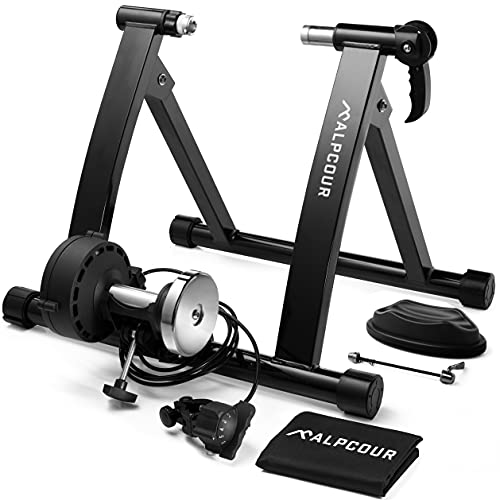
The Alpcour Mag Bike Stand converts any mountain or road bike into a stable indoor trainer with magnetic resistance and a smooth ride. It offers six fixed resistance levels controlled via a handlebar-mounted controller, enabling riders to simulate a range of hills and intervals. The stand emphasizes quiet operation and reduced friction to extend tire life, and its extra-wide base supports good balance on various floor surfaces. This option is well-suited for cyclists who want a sturdy, easy-to-use setup without complex adjustments every session.
Key considerations: A magnetic system provides reliable, repeatable resistance, and the six levels cover moderate training demands. The stand’s stability and noise reduction features appeal to riders sharing spaces with others. The footprint is moderate, so check room dimensions before purchase. It’s a solid choice for road riders seeking dependable indoor training with a straightforward interface.
Elite Arion Classic Roller With Air Resistance

The Elite Arion Classic Roller uses air resistance for a responsive, wind-driven feel that can scale with cadence. The roller frame is lightweight yet robust, designed for easy handling and storage. It folds to a compact footprint, making it suitable for home gyms or limited-space setups. Training power typically adapts with speed, delivering a progressive challenge as you pedal faster. This model is advantageous for riders who prefer an open, natural-feel resistance that grows with effort and speed.
Key considerations: Air resistance tends to offer a dynamic range that responds to your effort, which closely mimics outdoor riding but can be less predictable at very low speeds. The weight-to-transport ratio is favorable for portability, and folding storage simplifies rearranging a training space. If you value a light, quick setup and a realistic wind-like response, this roller is worth evaluating.
Buying Guide: Key Purchase Considerations
- Resistance type and range: Magnetic systems are quiet and adjustable, fluid stands provide progressive resistance with a life-like feel, and air resistance ramps up with speed. Consider your training goals—endurance, tempo, or intervals—and choose a system with a suitable progression.
- Stability and footprint: Rollers must stay centered and stable during the hardest efforts. Look for wide bases, reinforced frames, and, if space is limited, a foldable design.
- Bike compatibility: Ensure wheel size compatibility (commonly 26–29 inches) and consider if you need adapters for your bike’s frame or tires.
- Noise and maintenance: Magnetic and fluid systems typically run quietly and require minimal maintenance, whereas some air-based models can be louder with higher wear. Factor in your living space and tolerance for noise.
- Portability and storage: If you travel or ride in multiple rooms, prioritize foldable or compact units with carry handles or lightweight frames.
- Power requirements: Some models are self-contained (no external power), while others rely on electronic components. Decide if internal power sources or battery/mains compatibility matters to you.
- Training goals alignment: For structured workouts, seven- or six-level resistance offers clearer intervals; for realistic road feel, air or fluid resistance can enhance cadence-based training.
- Durability and warranty: Check frame materials, roller hub construction, and warranty terms to ensure long-term reliability for regular use.
In selecting a setup, balance the desired ride feel with space, budget, and training plan. For beginners, magnetic or assisted resistance options offer approachable entry points with reliable performance. More advanced riders may prefer fluid or air resistance for a more life-like climbing sensation and broader wattage ranges. Regardless of choice, a stable, well-supported trainer will help you maintain form and consistency during indoor cycles.