If you’re looking to deter bike theft, a reliable remote-controlled alarm can be a smart investment. These devices use motion or vibration sensors, loud sirens, and remote triggers to alert you and deter thieves. This guide highlights five strong options, comparing their sensor sensitivity, volume levels, weather resistance, and remote range to help you pick the best fit for your bike, e-bike, scooter, or motorcycle.
| Product | Brand | Key Feature |
|---|---|---|
| Wsdcam 113dB Bike Alarm Wireless | wsdcam | 66 ft remote range, IP55 waterproof, 7 sensitivity levels |
| POWVINE Max 110dB Bike Alarm | POWVINE | Remote up to 100m, 7 sensitivity levels, IP65 weather resistance |
| Cruxer Bike Alarm USB Rechargeable | Cruxer | 3D displacement sensor, 7 sensitivity levels, 3 volume levels |
| WSDCAM Bike Alarm 2 Pack | wsdcam | 2-pack, 113dB, remote control, 66 ft range, IP55 |
| PADONOW Wireless Remote Bike Alarm | PADONOW | 115dB, 3-level sensitivity, USB-C rechargeable |
Note: The products listed below are selected for relevance to the keyword “bike alarm with remote” and widely available on major retailers. Each entry includes a brief overview of its sensor sensitivity, volume options, weather resistance, and remote features to help you compare at a glance.
Wsdcam 113dB Bike Alarm Wireless
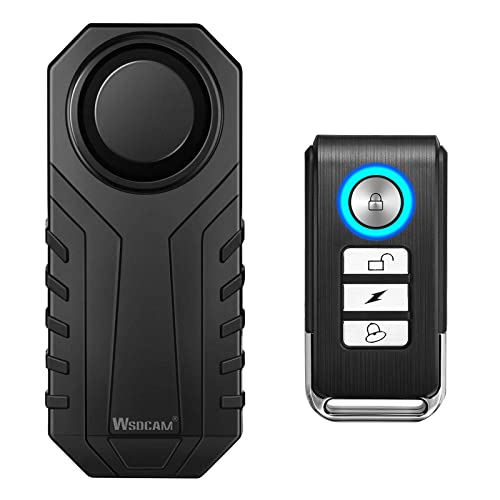
The Wsdcam 113dB bike alarm is designed for a broad range of two-wheeled vehicles, including bikes, e-bikes, motorcycles, and scooters. Its vibration alarm is calibrated with seven sensitivity levels and three volume levels, enabling customization to different environments—from busy city lots to quiet residential streets. The IP55 waterproof rating supports outdoor use, while wireless remote control offers convenience up to about 66 feet. This model is suitable for riders who want a straightforward, deployable security solution with flexible sensor settings and a sizable alarm output.
POWVINE Max 110dB Bike Alarm

The POWVINE Max 110dB bike alarm emphasizes high-decibel deterrence with a robust 110 dB siren. It offers seven sensitivity levels and three volume settings, enabling you to tailor alerts to your location—urban parking versus quiet neighborhoods. The remote control works up to about 100 meters and comes with a vehicle locator tone option for quick identification in crowded lots. Its IP65 weather-resistance adds protection against rain and dust, making it a practical option for frequent riders who park outdoors and want reliable anti-theft functionality.
Cruxer Bike Alarm USB Rechargeable

The Cruxer bike alarm uses a 3D displacement sensor to identify movement and reduce false alarms. It boasts seven sensitivity levels and three volume levels (90dB, 100dB, 110dB) with selectable ringtones. Installation flexibility is a key feature, offering bracket, strap, and double-sided tape mounting methods, making it adaptable for cylindrical frames and smooth surfaces alike. IP54 waterproof rating provides basic protection against rain, and the included installation tools simplify setup. This model is ideal for riders who want precise motion sensing and customizable audio feedback in a compact form factor.
WSDCAM Bike Alarm 2 Pack

The WSDCAM 2-pack combines two remote-controlled bike alarms with up to 113dB loudness and a 66-foot wireless range. It offers a vehicle search function to locate bikes in parking lots and provides three bell options for quick identification. Seven-level sensitivity and IP55 waterproofing support outdoor use, while the remote control adds convenience for arming and disarming from a distance. This bundle suits riders who want multi-bike coverage or a backup unit for shared storage spaces.
PADONOW Wireless Remote Bike Alarm
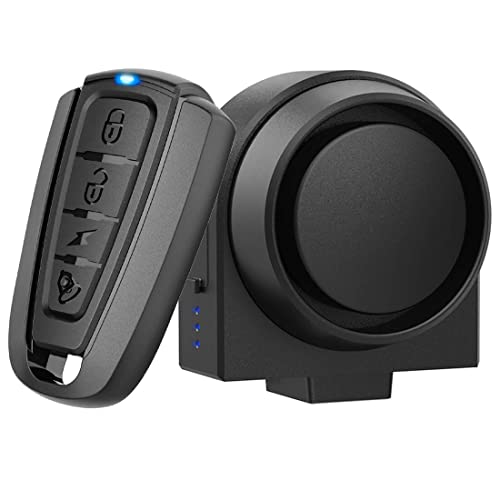
The PADONOW model features a 115dB alarm with USB-C rechargeability and three-level sensitivity, enabling quick adaptation to varying environments. Its motion sensor is designed to deter thieves with a piercing alert while remaining manageable for the user to control via remote. This unit is well-suited for riders seeking a high-decibel deterrent with modern charging convenience and straightforward setup for bicycles, scooters, and light motorcycles.
Buying Guide
Key considerations when choosing a bike alarm with remote include:
- Alarms and volume: Look for models offering multiple volume levels (at least 3) and high output (around 110–115dB) to deter thieves effectively.
- Sensor sensitivity: Seven levels of sensitivity help tailor responses to different environments, reducing false alarms in busy areas and ensuring alarms trigger on real movement.
- Remote range and control: A reliable remote range (50–100+ meters) improves convenience for locking and monitoring your bike from a distance; some models include vehicle locator features.
- Weather resistance: IP65 or IP55 ratings are common and indicate protection against rain and dust; higher ratings are better for outdoor use.
- Installation options: Flexible mounting (bracket, strap, adhesive) accommodates various frame shapes and surfaces.
- Power and maintenance: USB-C or rechargeable options reduce battery maintenance; consider backup power options for long trips or remote locations.
- Additional features: Some alarms offer SOS alerts, multiple tones, SOS or accident detection, or compatibility with multiple remotes; weigh these against your needs.
- Longevity and build: Look for robust housings and proven IP ratings to ensure durability in real-world conditions.
When selecting among models, consider your typical parking conditions (urban vs. rural), the type of vehicle (bike, e-bike, scooter, or motorcycle), and whether you want a single-unit or multi-pack system for multiple devices or backup units. Evaluate customer reviews and warranty terms to gauge reliability and support. Finally, match the features to your daily routines: frequent parking in shared lots may benefit from locator tones and higher remote reliability, while casual weekend use might prioritize ease of installation and battery life.