Finding the right charger for a 48V electric bike can improve charging speed, extend battery life, and reduce safety risks. The 48 volt ebike charger market offers several compatible options, each with different connector types, current ratings, and protection features. This guide highlights five highly relevant chargers to help riders compare options and choose a model that matches their batteries and riding needs. All selections emphasize safety, smart charging, and broad compatibility within the 48V/13S Li-ion ecosystem.
Summary of chosen products:
| Product | Brand | Voltage/Current | Key Features |
|---|---|---|---|
| 54.6V 2A Electric Charger for 48v | Fancy Buying Store | 54.6V 2A | Intelligent protection, high-temp resistant materials, fast heat dissipation |
| THEPRO 54.6V 2A Battery Charger | THEPRO Store | 54.6V 2A | Smart CC-CV charging, multi-protection, 5.5mm DC plug compatibility |
| EVAPLUS 5 in 1 Plugs 54.6V Fast Charger | EVAPLUS Store | 54.6V 1.5A | Five plug configurations, UL certified, overvoltage/overcurrent/temperature protection |
| Electric Bike Charger 48V, 54.6V 2A (5 Plugs) | Suptopone Store | 54.6V 2A | Universal 5-in-1 connectors, fast smart charging, LED status |
| EVAPLUS UL Certified 54.6V 1.5A | EVAPLUS Store | 54.6V 1.5A | UL certified, protection features, DC2.5/2.1mm options |
54.6V 2A Electric Charger for 48v
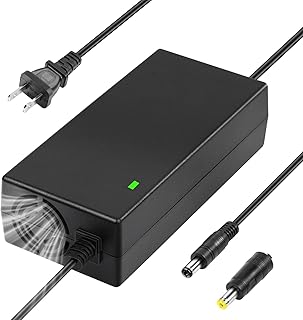
Designed for 48V to 54.6V Li-ion packs, this charger delivers 54.6V at 2A, enabling relatively quick top-offs for compatible batteries. It explicitly notes compatibility with 48V-54.6V systems and excludes 36V-42V units and lead-acid packs. The charger incorporates multiple safety protections, including voltage, over-current, over-temperature, and short-circuit safeguards, contributing to safer operation for daily use. A built-in aluminum heat sink and heat-dissipating design aim to maintain steady charging temperatures, though users may hear fan activity during operation as part of heat management.
Material quality is highlighted by high-temperature resistant ABS+PC housing, with a robust plug built from aluminum alloy and copper core. The kit is suitable for riders who prioritize safety features and reliable performance in a compact form factor. Note that noise from cooling may occur under load, which is typical for some active cooling designs.
THEPRO 54.6V 2A Battery Charger

THEPRO’s charger targets 48V 13S lithium batteries with a 54.6V 2A output and a DC 5.5mm X 2.5mm connector. It emphasizes smart charging with built-in protection for short circuits, overheating, overload, overcurrent, and overvoltage, operating in CC-CV mode for efficient charging. The device is marketed as fast while maintaining battery longevity, helping reduce downtime between rides. Before purchasing, confirm that your pack uses the compatible 5.5mm DC plug and the 13S configuration to ensure compatibility.
EVAPLUS 5 in 1 Plugs 54.6V Fast Charger
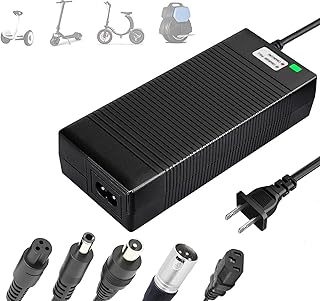
This model combines broad plug versatility with a 54.6V output rated at 1.5A, tailored for 48V 13S Li-ion packs. It ships with five plug options to support multiple devices, including 5.5×2.5/2.1mm connectors and adapters such as RCA, XLR, and IEC variants. UL certification adds a notable safety credential, with protections for overvoltage, overcurrent, short circuits, and temperature. This is a practical choice for households with more than one 48V device and a variety of charging ports.
Electric Bike Charger 48V, 54.6V 2A (5 Plugs)

This universal 5-in-1 charger accommodates a wide range of electric scooters, bikes, and ebikes via multiple connectors including 5.5×2.5mm, 1-prong DC, and additional mini-prong options, plus standard 3-prong and RCA/XLR variants. With 100-240V input and a 2A output at 54.6V, it supports quick charging while maintaining battery health through smart CC-CV operation. The LED indicator helps users track charging status from red to green, and the design prioritizes automatic maintenance to keep packs ready for the next ride.
EVAPLUS UL Certified 54.6V 1.5A Charger

EVAPLUS offers a 54.6V 1.5A charger with UL certification and multiple DC connector options (5.5×2.5/2.1mm) for compatibility with various 48V 13S Li-ion packs. It emphasizes protection for overvoltage, overcurrent, and short circuits, along with general thermal protection. The 54.6V output is designed to deliver efficient charging without stressing the battery, making it suitable for riders who want a compact, certified charging solution and flexibility in connector compatibility.
Buying Guide: Key Purchase Considerations
When selecting a charger for a 48V ebike system, consider these factors to ensure safety, compatibility, and performance:
- Battery compatibility: Verify the charger voltage (54.6V for most 48V 13S packs) and connector type to match your battery’s specifications and port geometry.
- Charging current: Higher current charges faster but can generate more heat. Match the charger’s current (e.g., 2A, 1.5A) to your battery’s recommended charging rate and thermal limits.
- Protection features: Look for overvoltage, overcurrent, short-circuit, and temperature protections. Multi-protection ensures safer charging in varied environments.
- Connector versatility: Some models ship with multiple plug options or universal adaptors, reducing the need for multiple dedicated chargers.
- Certification and safety: UL or equivalent certifications indicate adherence to safety standards, which is valuable for overall reliability.
- Heat management: Chargers with heat sinks or managed cooling minimize thermal stress during charging, extending charger life and battery safety.
- Portability and build quality: Durable housings (ABS+PC with metal contacts) and compact designs aid usability for traveling or commuting.
- User compatibility: Confirm the device compatibility table or listing details to ensure your specific ebike model or battery pack is supported.
- Maintenance and service: Availability of replacements or spare parts can be important for longevity and ongoing reliability.
Alternative considerations may include choosing a single universal charger with multiple plug configurations if you own multiple 48V devices, versus a model tailored to a specific battery form factor. Always refer to your battery’s manual for recommended charging currents and termination voltage, and avoid using a charger with a mismatch in voltage or connector.