Discover top 3D printed bike saddles designed to improve comfort, reduce numbness, and boost performance across road, mountain, and gravel biking. This guide highlights five standout options, detailing materials, ergonomics, and ventilation features to help you choose the right saddle for your riding style and terrain. Each pick combines advanced 3D printing with carbon fiber components to balance light weight and durability.
| Product | Brand | Key Benefit |
|---|---|---|
| ROCKBROS 3D Printed Bike Saddle 145mm | ROCKBROS Store | Shock-absorbing, breathable 3D resin cover |
| Fizik Vento Argo Adaptive | Fizik Store | Adaptive zonal cushioning with carbon shell |
| BUCKLOS 3D Printed Saddle | BUCKLOS Store | Fully adjustable 3D printed cushion with carbon rails |
| 3D Printed Bike Saddle Full Carbon T800 | — | Hexagonal lattice for airflow and relief, ultralight |
| BUCKLOS 3D Printing Saddle (Second Model) | BUCKLOS Store | Ergonomic design with 3D printing and carbon rails |
ROCKBROS 3D Printed Bike Saddle Review

The ROCKBROS saddle uses a 3D resin cover paired with a carbon fiber shell to deliver a smooth, supportive ride. Its ergonomic honeycomb surface provides a non-slip, breathable feel, helping to stabilize sit bones during long efforts. The combination of lightweight carbon fiber and a flexible cover aims to reduce fatigue on road and trail surfaces alike. While compatible with standard adapters, riders should confirm their seat post compatibility before installation.
Fizik Vento Argo Adaptive 3D Saddle

The Vento Argo Adaptive leverages carbon digital light synthesis 3D printing to create zonal cushioning that precisely supports targeted areas. Its short-nose design aims to minimize tissue pressure while maintaining stability. The shell combines ride-friendly carbon-reinforced nylon with a stiff carbon rail for an efficient, supportive ride, making it a strong choice for racers and endurance riders seeking responsive feedback.
BUCKLOS 3D Printed Mountain Saddle

BUCKLOS emphasizes 3D printing technology to fine-tune hardness and ductility across cushion areas, reducing shocks and improving comfort. An ergonomic design supports blood circulation and minimizes numbness, even in aggressive, aerodynamic riding positions. The frame uses a full carbon fiber structure with a lightweight profile, contributing to an overall low weight while maintaining durability for MTB, BMX, and gravel use.
3D Printed Bike Saddle Full Carbon T800
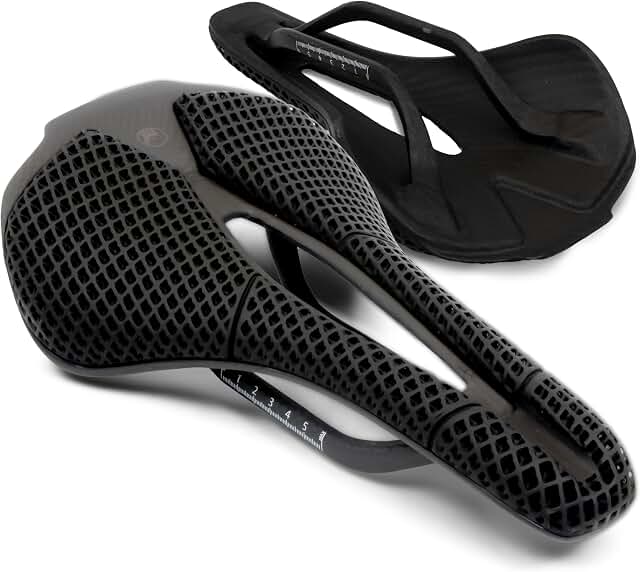
This saddle blends a hexagonal lattice interior with a hollow, breathable design to optimize heat dissipation and airflow. Weighing around 180 grams, it relies on T800 carbon fiber and anti-slip polymers to deliver high strength with minimal weight. The reinforced base and oval rails provide robust stability on challenging terrains while aiming to reduce fatigue on long road or mountain rides.
BUCKLOS 3D Printing Saddle – Second Model

The second BUCKLOS saddle emphasizes an ergonomic cut with a 3D-printed cushion and carbon rail system. The design aims to maintain comfort across varying riding styles, from fast-paced road efforts to steady endurance sessions. As with the other BUCKLOS models, the combination of 3D-printed geometry and carbon fiber components targets both weight savings and structural integrity for reliable performance.
Buying Guide: Key Considerations For 3D Printed Bike Saddles
When choosing a 3D printed saddle, riders should weigh comfort, compatibility, and ride intent. Consider the following perspectives to balance performance with personal fit.
- Ergonomics and sit bone support: Look for a saddle with a shape and relief zone designed to alleviate pressure on sensitive areas. Short-nose designs can help reduce soft tissue pressure for aggressive riding.
- Materials and construction: 3D printed saddles often use resin, carbon fiber shells, and lattice interiors. A carbon shell and high-strength rails typically offer better durability and weight savings, but may come at a higher cost.
- Ventilation and heat management: Lattice interiors and hollow designs promote airflow, reducing moisture buildup during long rides in hot climates.
- Weight versus durability: Ultra-light options trade some stiffness for weight savings. For rough terrain, ensure the rails and base are robust enough to withstand impacts.
- Compatibility and installation: Confirm seat post compatibility (bolt spacing and rail type) and verify that the saddle width (in mm) suits your bike frame and sit bone width.
What To Expect In Ride Feel
3D printed saddles aim to balance support and cushioning. Some riders notice enhanced pressure distribution and reduced numbness due to targeted relief zones. Others may require a brief adaptation period to the unique lattice structure, especially if they are switching from traditional foam saddles. For road riders, breathability and reduced weight can enhance comfort on long distances; for mountain riders, stiffness and stability may improve control on technical sections.
How To Choose Between Models
Compare the primary trade-offs: lightweight performance versus comfort on long rides, aerodynamic efficiency against comfort in urban or mixed-terrain use, and the level of customization available through 3D printed shaping. Riders should also consider warranty and post-purchase support when selecting a high-tech saddle.
Maintenance And Longevity
Regular inspection of rails and shell for cracks or damage is recommended. Clean the saddle surface to maintain the non-slip texture, and avoid harsh chemicals that could degrade resin surfaces. Proper installation and alignment can extend the saddle’s life and preserve comfort benefits over time.