This article highlights wheelchairs and pedal exercisers that help users stay active through integrated pedaling motions, supporting upper and lower body workouts at home. Each product below offers different resistance, portability, and comfort features designed for seniors, rehab patients, and anyone seeking low-impact exercise. Read through to compare design, use cases, and portability to find the best fit for daily workouts and therapy goals.
| Product | Brand | Primary Use | Key Benefit |
|---|---|---|---|
| HNLIY Legs Arms Electric Exercise Bike Active Passive Knee Pedal Trainer | HNLIY | Upper and lower body rehab | Two independent motors for simultaneous or separate training |
| Mini Exercise Bike TODO Pedal Exerciser | TODO | Desk or floor use | Compact, portable with LCD monitor |
| Folding Pedal Exerciser, AGM | AGM | Arm and leg workouts | Foldable design, safe non-slip pedals |
| Pedal Exerciser Bike Hand Arm Leg and Knee Peddler | NISDOKR | Total body rehab | Adjustable tension, massage function options |
| Pedal Exerciser Desk Exercise Bike by MEMEDA | MEMEDA | Desk-based leg and arm workouts | Under-desk use, portable with adjustable tension |
HNLIY Electric Exercise Bike For Rehab

This electric pedal exerciser is designed for both arms and legs, featuring two independent motors that allow users to train the upper and lower body either together or separately. The device targets a range of conditions, including stroke recovery and joint mobility. A clear display shows time, pace, distance, and calories, while a 60W motor supports gentle, controlled movements. Timer options span 1 to 20 minutes, with automatic program switches (P1-P6) to accommodate different fitness levels. The unit is marketed as a lightweight home-use rehab machine that can aid joint flexibility, blood circulation, and endurance, and it supports active or passive exercises to improve knee and limb activity.
Mini Exercise Bike TODO Pedal Exerciser

Compact and portable, this pedal exerciser is suitable for both leg and arm workouts, making it a versatile option for office or home use. It features a lightweight design with nonslip surfaces and adjustable toe loops for comfort and safety. The device is quiet and smooth, enabling exercise while engaging in daily tasks like phone calls or TV viewing. The LCD monitor tracks Time, Distance, Count, Total Counts, and Calories, allowing users to monitor progress with a single button to switch data and reset when needed.
Folding Pedal Exerciser by AGM
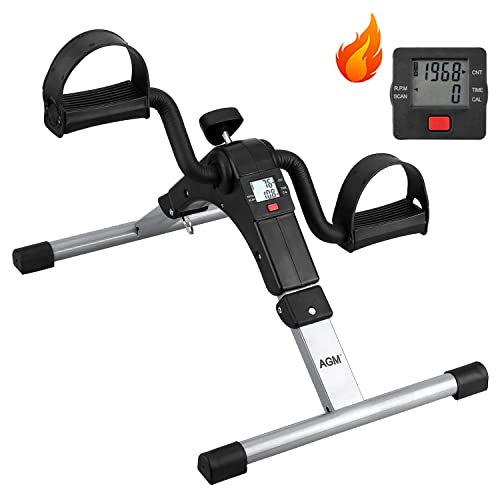
AGM’s folding pedal exerciser supports both arm and leg workouts and can be used on a table top for arm exercises or on the floor for leg workouts. Its foldable design makes it easy to store and transport, ideal for small spaces or travel. The unit emphasizes safety with non-slip pedals and adjustable foot straps to fit users of varying sizes, ensuring stable movement during use.
NISDOKR Pedal Exerciser Bike for Rehab

This dual-purpose pedal peddler is designed for total body rehab with adjustable tension and height to accommodate arm and leg work from a chair or sofa. It highlights a home-rehab focus, including gloves for support and a compact footprint for easy placement in living spaces. The frame is built from sturdy materials with rubber pedals and suction cups to improve stability, and the base includes a foot massager roller for added comfort. The design supports safe, low-impact workouts for stroke or muscle-weakness recovery.
MEMEDA Desk Exercise Bike For Arms And Legs

Designed for under-desk use, MEMEDA’s pedal exerciser supports leg and arm workouts in a compact, portable form. It emphasizes adjustable tension to tailor resistance for warm-up or recovery sessions. The lightweight build and user-friendly LCD monitor enable easy tracking of workout metrics in sit-down scenarios, making it a practical choice for office workers or light home rehab routines. The device encourages ongoing activity without requiring standing or heavy equipment.
Buying Guide: Key Purchase Considerations
When selecting a pedal exerciser or wheelchair with integrated cycling motion, consider how the device will fit into daily routines and therapy goals. Below are critical factors to evaluate from multiple angles:
- Intended user and rehabilitation goals: Choose devices with resistance ranges and adjustability that align with mobility levels, injury history, and therapy plans.
- Ease of use and accessibility: Look for simple assembly, intuitive controls, easily readable displays, and comfortable hand/foot interfaces for seniors or individuals with limited dexterity.
- Portability and storage: If space is limited or travel is needed, foldable designs and lightweight frames are advantageous.
- Stability and safety: Prioritize non-slip pedals, secure straps, suction bases, and sturdy frames to minimize movement during exercise.
- Monitor and feedback: LCD or digital readouts for time, distance, calories, and repetitions help track progress and motivate regular use.
- Versatility for arms and legs: Some models are optimized for one limb; others offer adjustable tension or dual-motor setups to support combined or separate limb training.
- Maintenance and durability: Consider materials, ease of cleaning, and resistance to wear, especially in home rehabilitation environments.
- Cost and warranty: Compare upfront costs against features and available warranties to ensure long-term value and dependable support.
- Compatibility with cushions and chairs: If the user sits for long periods, ensure seating arrangements and product dimensions accommodate comfort and accessibility.
What It All Means For Buyers
For users seeking integrated pedaling workouts, pedal exercisers provide a flexible approach to maintain circulation, joint mobility, and muscle engagement without high-impact stress. While true wheelchairs with built-in pedal systems are less common, the above devices offer practical alternatives that support similar rehabilitation and fitness goals in home settings. Evaluate how each unit’s design—whether desk-friendly, foldable, or dual-arm/leg capable—fits into daily routines and therapy plans.