Updating a traditional mountain bike into an assisted ride is easier than ever with modern conversion kits. This guide highlights five top options that balance power, reliability, and installability for American riders who want confident climbing, steady cruising, and smooth throttle control on rugged terrain. Each kit includes essential components for a direct upgrade, with some offering rear-wheel or front-wheel configurations and mid-drive options. Compare features, compatibility, and performance to determine which kit best suits your mountain biking goals and budget.
Summary of chosen products
| Product | Brand | Type | Key Benefit |
|---|---|---|---|
| LIVALL PikaBoost 2 E-Bike Conversion Kit | LIVALL | Rear-wheel | App control, two battery options, quick install |
| Ringmaster 1000W Rear Wheel Kit | Ringmaster | Rear-wheel | High efficiency, PAS sensor, solid build |
| AW 1000W 26″ Front Wheel Kit | AW | Front-wheel | High compatibility, durable frame, three riding modes |
| BAFANG BBS02B/BBS-HD Mid-Drive Kit | BAFANG | Mid-drive | High torque, adaptable to many bikes, versatile speed |
| PEXMOR 1200W Front Wheel Kit | PEXMOR | Front-wheel | Powerful 1200W, multiple modes, strong PAS |
LIVALL PikaBoost 2 E-Bike Conversion Kit

The LIVALL PikaBoost 2 is a rear-wheel conversion kit designed for quick installation on round seatposts (25-35mm). It emphasizes a secure, tool-light fit that avoids extra wiring. A notable feature is seamless switching between e-bike and standard riding modes, simplifying ride preference on demanding trails. The kit ships with a multi-layer Battery Management System (BMS) for safety. Available battery capacities include a 220Wh model offering up to about 43 miles (70 km) in optimal conditions and a 158Wh model offering roughly 31 miles (50 km). A 65W USB-C charger is recommended for charging.
Ringmaster 1000W Rear Wheel Kit

This kit centers on a 1000W brushless and gearless rear-wheel motor. Constructed from aluminum and other durable materials, it resists rust and wear through long rides. The pedal assist sensor (PAS) adjusts motor speed in response to pedal cadence, enabling riding with minimal throttle intervention—handy for long climbs or fatigue-prone trips. Reported efficiency exceeds 82%, with top speeds around 26.72 mph. The design prioritizes stability and responsive handling, making it suitable for mountain routes where consistent power delivery matters.
AW 48V 1000W Front Wheel Kit
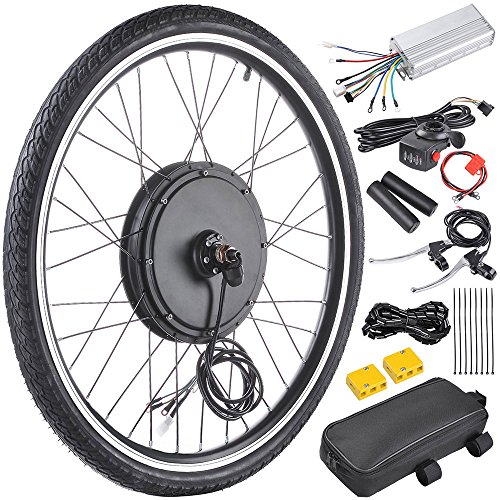
The AW front-wheel kit uses a 48V, 1000W brushless motor to deliver up to about 27 mph. The aluminum alloy frame supports up to 220 pounds, offering solid durability for mountain bikes and other builds. The kit includes a thumb throttle with battery-status indicators and a compact controller. It supports 26″ wheels and is compatible with both disc and V-brakes. This configuration suits riders seeking front-wheel drive and straightforward upgrades with a reliable power source and wheel installation.
BAFANG Mid-Drive Kit 750W/1000W

The BAFANG BBS02B/BBS-HD mid-drive system offers a comprehensive upgrade with a bottom-bracket motor that blends power and efficiency. Compatible with 68-73mm bottom brackets, this kit supports multiple frame lengths and disc or V-brake constraints. It delivers high torque for challenging terrain, with speeds up to 45 km/h (around 28 mph). The kit includes or offers optional components like a battery and LCD display. For riders wanting a mid-drive experience that leverages bike gears, this is a strong, widely supported option.
PEXMOR 1200W Front Wheel Kit

The PEXMOR front-wheel kit features a robust 1200W brushless hub motor with a sine-wave controller, designed for efficiency and lower noise. It supports 26″ frames with 100mm front dropouts and includes a PAS/LCD/Twist Throttle arrangement. The controller offers four riding modes, with pedal assist and throttle options for versatile riding on varied terrain. This configuration is ideal for riders seeking maximum front-wheel power on mountain routes or longer, steep climbs where a strong assist is beneficial.
Buying Guide: Key Considerations For Choosing A Conversion Kit
- Mounting configuration: Front-wheel, rear-wheel, or mid-drive. Front-wheel kits are simpler to install but can affect steering on rough terrain; rear-wheel kits can improve traction; mid-drive kits leverage the bike’s gears for balanced torque on hills.
- Power and torque: Wattage (W) and torque determine climbing ability and top speed. Mountain use benefits from higher torque and reliable cooling for extended climbs.
- Battery capacity and weight: Larger capacity extends range but adds weight. Assess how range and weight affect your bike handling and ride style.
- Controller and modes: Look for multiple assist modes, PAS responsiveness, and whether throttle is available. A sine-wave controller can reduce motor noise and improve efficiency.
- Compatibility: Check wheel size, axle type, brake compatibility (disc vs V), and bottom bracket specs for mid-drive kits. Ensure the frame and fork can accommodate the added weight and electrical components.
- Installation simplicity: Some kits offer tool-free or quick-install options, while mid-drive kits may require more mechanical work. Consider whether you want a DIY fit or professional installation.
- Maintenance and service: Consider brands with local support, spare parts availability, and robust documentation. A widely supported kit is easier to service over time.
- Safety features: Battery protection, secure motor mounting, and reliable wiring reduce risk on rugged trails. Look for BMS protection and IP-rated components where applicable.
- Regulatory considerations: Be aware of local laws regarding electric bike classifications and speed limits for sub-750W or mid-drive systems.
All included products offer distinct advantages depending on riding style, terrain, and maintenance preferences. Rear-wheel kits typically prioritize traction and simplicity on rugged paths, while front-wheel and mid-drive designs provide nuanced torque distribution for climbs and technical sections. Battery choices, control interfaces, and post-install maintenance should guide your final decision to ensure reliable, long-term performance on American mountain trails.